
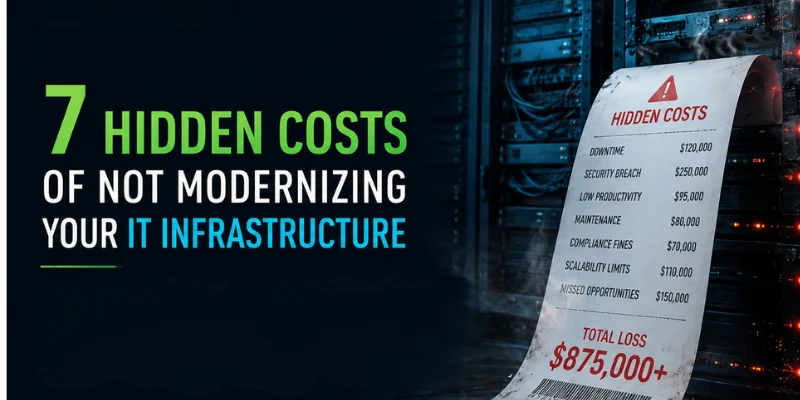
Your infrastructure still works. Your applications are running. Customers can access your website.
So why change anything?
This is where many businesses get stuck.
Legacy infrastructure can feel like the cheaper option because you don’t have to replace everything at once. But there’s a catch: old infrastructure can cost you money in ways that don’t show up clearly on an IT budget.
Your developers spend more time fixing problems. Releases take longer. Scaling becomes harder. Security risks grow. And when something breaks, the business feels the impact.
The real cost isn’t always the server bill.
It’s everything your business loses because your technology can’t move as fast as your business needs to.
Let’s look at seven hidden costs of delaying infrastructure modernization.
1. You’re Spending More Just to Keep Things Running
Older infrastructure often needs more hands-on work.
Someone has to maintain servers, replace aging hardware, monitor systems, manage software, troubleshoot issues, and deal with unexpected failures.
None of these tasks sound huge on their own. But they add up.
You may be paying for:
- Hardware replacements
- Software and licensing renewals
- Manual server management
- System monitoring
- Emergency troubleshooting
- Infrastructure upgrades
- Time spent maintaining old systems
And here’s the part businesses sometimes miss.
Your IT team isn’t just spending money on infrastructure. They’re spending time on it too.
Instead of working on projects that improve your product or customer experience, skilled employees may be stuck keeping older systems alive.
Modern infrastructure can reduce some of this manual work through automation, cloud services, and better resource management.
That means your team can spend less time asking, “Why did this break?” and more time working on what comes next.
2. Slow Releases Can Mean Missed Opportunities
Imagine your competitor launches a feature customers have been asking for.
You already have the feature almost ready.
But getting it into production takes weeks because deployments involve manual steps, testing takes too long, and everyone is worried that one small change might break something else.
That’s not just an IT problem.
That’s a business problem.
Legacy infrastructure can make it harder to release:
- New product features
- Software updates
- Security patches
- Customer-requested improvements
- New services
And when releases take longer, opportunities can disappear.
Modern development environments use automation and deployment pipelines to reduce manual work and make software delivery more predictable.
The goal isn’t simply to release software faster.
It’s to give your business the ability to respond when something changes in the market.
3. Downtime Costs More Than You Think
What happens when your application goes down for an hour?
Customers can’t place orders.
Employees can’t do their work.
Support teams start receiving complaints.
And your technical team is suddenly focused on getting everything back online.
The cost can include:
- Lost revenue
- Disrupted operations
- Lower employee productivity
- Customer frustration
- Damage to your reputation
And as your business grows, the problem can become worse.
An infrastructure setup that worked well for 10,000 users may not behave the same way when demand increases significantly.
This is where modern infrastructure can make a big difference.
Better monitoring, automated scaling, fault-tolerant architecture, and cloud-native systems can help businesses build applications that are more resilient when demand changes or something goes wrong.
Because the real goal isn’t to prevent every failure.
That’s almost impossible.
The goal is to make sure one failure doesn’t bring everything down.
4. Old Infrastructure Can Create Bigger Security Problems
Here’s something that’s easy to ignore:
Technology doesn’t stay secure just because it has been working for years.
Security threats change. Software gets outdated. Systems stop receiving updates. Access controls that were acceptable several years ago may no longer be enough.
Older environments may lack things like:
- Modern authentication
- Strong access controls
- Automated patch management
- Centralized security monitoring
- Better visibility across systems
For businesses with regulatory or compliance requirements, the problem can become even more complicated.
A security incident doesn’t just create technical work.
It can lead to financial losses, operational disruption, legal problems, and a loss of customer trust.
Modern infrastructure can make security easier to manage by giving teams better visibility, centralized controls, automated updates, and more consistent security practices.
It’s not a magic solution to cybersecurity.
But it can give your team a much stronger foundation to work with.
5. Growth Becomes a Technology Problem
Business growth is supposed to be a good thing.
More customers. More traffic. More sales. More opportunities.
But what happens when your infrastructure can’t keep up?
You may suddenly need to handle:
- Higher website traffic
- More application users
- Increased customer demand
- New markets
- Larger workloads
With traditional infrastructure, scaling can mean buying additional hardware, configuring systems manually, or even dealing with downtime during major changes.
That’s not exactly the kind of flexibility a growing business needs.
And this is where technologies such as Kubernetes can become useful.
Kubernetes helps manage containerized applications and can make it easier to scale workloads based on demand.
Instead of building your infrastructure around today’s traffic, you can create an environment that’s better prepared for tomorrow’s growth.
That’s a major difference.
Your infrastructure should support business growth, not put a limit on it.
6. Your Developers May Be Spending Too Much Time on Infrastructure
Here’s a simple question:
What should your developers be doing?
Building products. Improving features. Fixing customer problems. Creating things that help the business grow.
But in older environments, developers can end up spending a surprising amount of time dealing with infrastructure issues.
Things like:
- Manual deployments
- Configuration problems
- Different environments behaving differently
- Repetitive maintenance
- Infrastructure troubleshooting
- Deployment failures
None of this directly improves your product.
It simply takes time away from the work that does.
This is one reason DevOps and automation have become so important.
With the right tools and processes, repetitive infrastructure tasks can be automated. Developers can get more consistent environments, smoother deployments, and fewer manual steps.
The result isn’t just better infrastructure.
It’s more productive engineering teams.
7. The Biggest Cost May Be Falling Behind
This one is harder to measure.
But it may be the most important.
While your business is trying to maintain older systems, competitors may be using modern infrastructure to move faster.
They may be able to:
- Launch features sooner
- Scale applications more easily
- Improve digital experiences
- Support new technologies
- Enter new markets faster
- Experiment with new ideas
Meanwhile, your team may still be asking whether the existing infrastructure can handle the next change.
That’s how a technology gap starts.
It may not be obvious today.
But over time, the gap can become harder and more expensive to close.
Modern Infrastructure Isn’t Just About Moving to the Cloud
For businesses unsure where to start, Cloud Consulting can help identify the right modernization path.
There’s a common misunderstanding about modernization.
Some businesses think it simply means moving everything from physical servers to the cloud.
It doesn’t.
Moving an old application to the cloud without changing how it’s built or managed doesn’t automatically make it modern.
Real modernization is about creating an environment that is easier to scale, automate, monitor, secure, and improve.
Depending on your business, that could involve:
- Cloud platforms
- Kubernetes
- DevOps practices
- Automation
- Infrastructure as Code (IaC)
- Containerization
- Better monitoring
- More reliable application architecture
The right approach depends on what you’re running today and where you want to go next.
That’s why a modernization plan should start with your actual business and technology problems—not with a list of trendy tools.
So, Is It Time to Modernize?
You may want to take a closer look at your infrastructure if:
- Software releases keep taking longer
- Infrastructure costs continue increasing
- Downtime is becoming more common
- You don’t have a clear view of cloud spending
- Developers spend too much time fixing infrastructure issues
- Scaling applications is becoming difficult
- Security and compliance are getting harder to manage
If several of these sound familiar, the problem may not be one broken server or one slow application.
It could be the infrastructure underneath your entire technology environment.
And that’s worth looking at before the problem becomes much more expensive.
You Don’t Have to Modernize Everything at Once
Another common mistake is thinking infrastructure modernization means replacing everything immediately.
It doesn’t have to.
For organizations that don’t have enough internal expertise, choosing to Hire DevOps Engineers can help move modernization projects forward.
A better approach is usually to understand what you have first.
From there, you can identify the systems creating the biggest problems and decide what should be modernized, automated, migrated, or replaced.
Infrastructure specialists can help with areas such as:
- Assessing existing infrastructure
- Creating a modernization roadmap
- Moving workloads to the cloud
- Introducing automation
- Improving application reliability
- Managing cloud costs
- Implementing DevOps practices
- Building and managing Kubernetes environments
For organizations that don’t have enough internal expertise, bringing in dedicated DevOps Engineers or Kubernetes Developers can also help move modernization projects forward without having to build an entire specialized team from scratch.
The Real Cost of Waiting
The biggest mistake is thinking that outdated infrastructure is free because it’s already paid for.
It’s not.
You’re paying through slower releases, manual work, downtime, security risks, scaling problems, and lost opportunities.
And the longer you wait, the harder it can become to catch up.
Modern infrastructure isn’t about having the newest technology just for the sake of it.
It’s about giving your business a technology foundation that can keep up with what you’re trying to build.
Whether you’re planning a cloud migration, adopting DevOps, introducing Kubernetes, or simply trying to make your existing systems more reliable, modernization can help you build for what’s ahead instead of constantly working around what’s already there.
If you’re exploring infrastructure modernization, SparkSupport can help you evaluate your current environment and plan a practical path toward cloud-native technologies, automation, and scalable infrastructure.
If you’re ready to look at what’s slowing your infrastructure down, Contact Us to start the conversation.
Great article!