
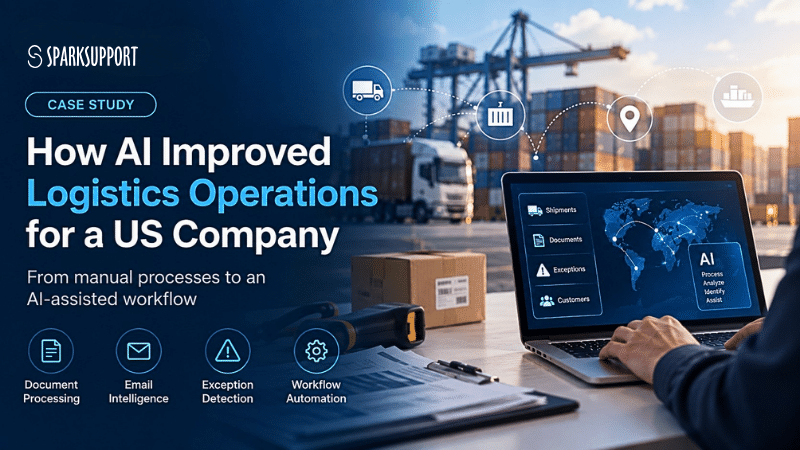
A US logistics company handling growing shipment volumes.
The company was managing a growing volume of shipment information across customers, locations and operational workflows. As the volume increased, processing and reviewing shipment information manually became more time-consuming.
AI-Assisted Shipment Processing
An AI-assisted workflow was introduced to help process shipment information, identify unusual cases and reduce repetitive operational work.
The approach combined AI automation with human review, allowing the logistics team to keep control of important decisions while reducing the amount of routine manual processing.
More shipments meant
more manual work.
The logistics team had the information they needed, but a large part of the process still depended on people reviewing, processing and checking shipment information manually. As shipment volumes grew, this created additional operational effort and made exception handling harder.
Growing shipment volumes
Repetitive manual processing
Time-consuming information review
Manual exception identification
Reduce repetitive work with AI-assisted operations.
The goal was not to replace the operations team. It was to use AI where it could handle repetitive processing and help people focus on exceptions, validation and decisions that still required human involvement.
Understand → Automate → Assist
Understand
We looked at the existing shipment workflow and identified repetitive tasks where AI could provide practical value without disrupting the existing operation.
Automate
AI was introduced to help process shipment information, identify relevant information and reduce repetitive manual processing.
Assist
AI-assisted results were presented to the operations team so people could review exceptions, validate information and take the appropriate action.
From shipment information
to actionable information.
Instead of relying entirely on manual processing, the workflow uses AI to assist with repetitive shipment-related tasks and surface information that requires attention.
This gives the operations team a more structured way to process shipment information while keeping people involved where validation or decision-making is required.
- Shipment information processing
- Data extraction and classification
- Exception identification
- AI-assisted operational review
- Human validation and decision-making
Less repetitive work.
More focus on operations.
Faster processing
AI-assisted processing helps reduce the amount of repetitive work involved in handling shipment information.
Better exception visibility
Relevant cases can be surfaced for the operations team instead of relying entirely on manual checking.
Human-led decisions
Teams remain involved where validation, judgement or operational decisions are required.
From manual processing
to AI-assisted operations.
AI development backed by ongoing engineering support.
The solution can be supported through an AI engineering team working around the client’s workflow and technical requirements. This can include AI engineers, software engineers and technical support based on the scope of the engagement.
The team can continue to support improvements, workflow changes, technical enhancements and new AI capabilities as the logistics operation evolves.
The focus is not simply on delivering an AI feature. It is on building a solution that continues to be useful as the business grows.
Logistics teams don’t need AI just for the sake of AI.
They need technology that can remove repetitive work, help teams process information faster and make everyday operations easier to manage.
By starting with the workflow and identifying where AI can genuinely help, businesses can introduce automation without losing the human oversight that important operational decisions often require.
Find where AI
can make a difference.
Tell us what your team is spending time on. Let’s explore where AI and automation can help your business work smarter.
Talk to our AI engineering team →